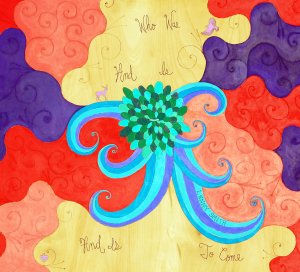
This is an older review of the Lenny Smith’s Who Was and Is and Is To Come, originally posted on this site in July of 2012:
It’s been an odd couple of weeks, what with hurricanes sweeping through cities and towns, politicians battling over the fate of the world, rumors of wars and so forth. Waters have risen and subsided. Lights have dimmed and become alive again. Doomsday prophets and naysayers abound, as they always have, and more will come I’m sure.
Amidst it all, there arrives the new Lenny Smith album, Who Was and Is and Is To Come (released on Great Comfort Records), a mix of 60s style folk and rock tunes inspired by the artist’s lifelong search of an unknown Creator. In stark contrast to the turmoil of the times, Smith enters quietly. Gently fingerpicking a sparse folk melody, drawing upon his many hours of scripture reading, Smith sings the first song he ever wrote,
Then I saw a new Heaven— and a new Earth, the New Jerusalem.
As a young seminary student in the 1960s, Smith would hide in the closet at night, writing songs and reading scripture. The strange poetry of Revelation and its pronouncement of a New Jerusalem struck a deep chord.
God Himself will wipe every tear from their eyes
and death shall be no more.
As the album progresses, we get glimpses of Smith at different stages of his journey, from the theology obsessed student putting melodies to the psalms (“As a Doe Longs for Running Streams”), to the wizened grandfather looking back on all he’s learned (“All the Earth Worships You”).
You are the love I feel inside
And Your love won’t be denied…
Smith’s words are void of brimstone. His ruminations are simple, sometimes hushed, as he beckons to hear that still, small voice. But the journey isn’t just about introspection. It’s about celebration. Along the way, his many friends, children and grandchildren join in, elatedly plucking strings, playing keys and shouting along in joyous unity.
There is something very fitting about it all. While so many are calling down fire from heaven, eagerly awaiting a swift vengeance, Smith is gently up turning evidence of his Maker in the quiet spaces; beneath sheets of darkness and layers of corrosion; in the trees and rocks, and inside of his very soul. “The earth”, he writes in the liner notes, “knows something”. These are words of reconciliation and healing that we could all use right now.
Who Was and Is and Is To Come is available at http://lennysmith.bandcamp.com/

It’s easy to sink into indifference. Looking out upon a world drenched in blood and smoke, it’s tempting to turn your back—to hitch a first class ticket onto a gospel train bound for Glory, while the world is left to smolder along the track. That is why it’s necessary to have a folk singer like David Benjamin Blower around. Blower follows a long line of prophets and protest singers—from Elijah to Woody Guthrie—who shift our gaze outward, to the greed and exploitation that burns in the world. His latest record, Welcome the Stranger, is immediate and fierce, drawing on the empirical imagery of the Old and New Testaments, and the Dust Bowl tunes of Guthrie, reminding us all that the world didn’t get better after the dust of the Great Depression settled. He sings of the displaced and the refugee, giving voice to their hardship. He sings with love, with brutality, and with anger, using his guitar and voice as a jackhammer to smash through the apathy of our age.
You can listen to and purchase the album at https://benjaminblower.bandcamp.com/
All proceeds from the record will go to charities working directly with refugees.
The Wandering Boy: Wesley Randolph Eader’s “Of Old It Was Recorded”
October 10, 2013

Last night, under a sky full of stars, I drove the gravel back roads that lead to my grandparents’ house. I followed a barbed wire fence that vanished and reappeared in the dark fields along the road. A rusted oil well stood silent on the other side of the fence, and beyond it were trees and hills that I had explored tirelessly through youthful summers. The fence gave way to houses and garages and allotments of land that had been parceled out a few years back, breaking up a good chunk of the forest of my childhood.
It’s like that in a lot of places these days. Economies ebb and flow. Demands and resources change. Fertile towns go dry and family farms go under.
I’ve had fits of nostalgia driving those roads before, but not last night. I was listening to Wesley Randolph Eader’s album, Of Old It Was Recorded, and perhaps it gave me a sense of the eternal, and a hope that some things never pass away. Void of any sort of contemporary sheen, Eader’s songs of blood and redemption, set against gentle Appalachian melodies, are something out of time. Like the old trees that still stand among the model homes and driveways, the album is unabashedly “old-sounding” amidst a brave new world.
Eader, reflective and unassuming, has always felt like an old soul tossed into the wrong generation. Growing up the son of a pastor in a small Washington town, he fled to Portland, Oregon in his early 20s in hopes of finding some anonymity. There, in that oasis of diversity, conformity out of the question, his identity began to take shape. He found solace in the old timey music he had brushed against in trips to Tennessee. And he found a renewing of his spirit in the worshipping assemblies he met there.
It was ministry that took the Eader family to the West Coast in the first place; first to Oregon, where Wesley was born, and then to the shipping town of Kalama, Washington. Though Wesley felt the strain of expectations that most ministerial families face, he also saw the deepness of his family’s professed faith as well. He says, “I think the most memorable moments from my youth, those that impact me still today, are was when I would witness the change that occurs when people encounter the gospel for the first time”. His father would sometimes feed and open their home to the lonely Chinese shipmen, far away from home and language, who would make port in Kalama. The Eader family would tour the ships and get to know the freight workers. Wesley would witness the grit and beauty of his father’s hospitality. “I think seeing the gospel have a positive impact in peoples lives is what allows me to continue to believe in its power”.
Eader carried those ideas with him to Portland, where he began to carve out his own path of faith, experiencing God in new and unusual ways. In a small, packed room, stacks of Bibles and hymnals piled about, Wesley and his friends would pray and sing for hours; rejoicing together, struggling together, and grappling with the great Unknown together. He says, “It really felt like we were in the middle of a genuine revival”.
It was in this time of intense worship, that Eader began to take seriously the idea of gospel music. He reflects, “I had kinda told myself that all the best gospel songs/hymns had already been written…that nobody could say anything better than the great hymnists like Watts, Cowper or Crosby and no one could perform them better than guys like Johnny Cash or the Stanely Brothers”. The modern Christian music scene, much of it a repackaging of faith with radio hooks, didn’t sit well with Eader. Taking faith–that eternal idea that outweighs and outreaches everything that we know–and trying to box it up…there’s oftentimes very little honesty in something like that, and it gave him a bad taste in his mouth for gospel music.
But the more he thought about it, the more he started to wonder: Isn’t gospel music the forefather of our American music traditions? Our country and blues and folk music…weren’t they born out of the gospel tradition? When did gospel start following trends as opposed to setting them? When did it get turned around?
In that small, packed room of worship, Wesley witnessed the power that a well-written hymn can have when the poetry and theology is taken seriously again. Sometimes those old hymns get a little too embedded in our lives. Sometimes they get a little too familiar, like children’s songs. But strip those melodies down to a single guitar, strumming a few chords; put a weathered weight-of-the-world voice behind the words…and you can feel that fire again. You can’t help but sing along.
Eader’s songs are definitely imbedded in those classic traditions of gospel songwriting. He doesn’t shy away from the bloody imagery, or paper over those grand themes of resurrection and atonement. But he also writes through the lens of his own Christ-experiences; and emphasizes, first and foremost, the love of Christ.
Oh perfect love come near to me
From hatred let me part
So I can bless my enemies
With glimpses of Thy heart
The recording process was pretty modest. Recorded by Blitzen Trapper’s Eric Early, they set up a microphone in Earley’s living room. Wesley whittled his catalogue down to 10 songs, and for the next two hours, using just his voice and a guitar, they ran through them all. Afterward, Early and a few musicians added strings and other subtle instruments to fill out some of the songs.
But despite those little touches, there’s very little polish to be found on the record. Though probably not the case, the album sounds like it was recorded the old fashioned way, long before tape and digital allowed for second chances and manipulated files. There’s a lived-in feeling to it, and a delicate echo that permeates. Eader sings each song as if he’s been singing them forever…as if they were passed down like precious heirlooms, or discovered on one of A.P. Carter’s song expeditions.
And that valley may be dark
Over all the earth, extended
But the love of God is brighter
And its path cannot be bended…
Eader explains that, “We live in an age marked by anxiety and uncertainty, often burdened the past and fearful of the future…Many of us fail to find value in the present moment because we fear it will be forgotten forever, but the gospel teaches us the opposite: that the present moment is holy because it is marked by eternity”. There’s a hope there for someone like Eader, whose heart lay in centuries long past. And there’s a hope there for the rest of us nomads as well, whose attachments get swept away in the currents of progress.
I think it was that, or something close to it, that gave me a sense of comfort on my back road drive. I still walk those woods sometimes. I still climb those hills and cross those streams, moving among the tall grass and broken branches. But 1988 is gone, and so is 1938. You have to hold onto the things that last a little longer…songs and traditions and the redeeming blood of Christ.
Of Old It Was Recorded can be found at Amazon, Bandcamp, and most online retailers; as well as noisetrade.
References
Eader, Wesley Randolph. Email interview. July, 2013.
The Old Paths: “Help Me to Sing”
June 23, 2013

It was probably two years ago that I attended my first Sacred Harp singing. The closest one I could find was in Columbus, Ohio, a two-hour drive. The winter sun was beginning to set as I pulled into the empty parking lot of the borrowed Episcopalian church (which has no denominational connections to the group, or to the style itself). Soon, somebody else arrived. It was Eric, the group’s leader. He let me in and I flipped through the pages of the Sacred Harp songbook as he set up chairs in a square formation.
The Sacred Harp has been around for roughly 150 years. It’s origins are scattered across many southern states, but you can somewhat trace the tradition back to B.F. White and Elisha J. King in Georgia, who first organized the Sacred Harp songbook in 1844. The two compiled melodies and lyrics that drew upon the southern style of shape note singing. Within the style, notation is condensed to four notes, with a symbol representing each one (triangle for fa, oval for sol, square for la, and diamond for mi). As each hymn begins, the choir “lines out” the song by singing the notes aloud, establishing the melody. It’s an eerie sound, unlike anything else that I know of in sacred music (or in music in general).
White, King, and the wealth of singers and writers who contributed to the sacred harp tradition weren’t creating this new form of music from nothing. They were absorbing years of sacred writings and hymns; songs that had travelled down mountains and over oceans; and they were transforming them into something much different. The Sacred Harp songbook is a vast trove of ancient lyrics put to ghostly melodies. Some of the words may have been contemporary to the first printings of the songbook, but many preceded the tradition by generations.
Sitting in the recreation room of the church, I turned to one such adaptation. It was a tune called “Idumea”, number 47b in the book. Charles Wesley’s hymn, written in 1763, has seen many alterations over the centuries, none more notable than it’s sacred harp translation. My favorite is probably Doc Watson and Gaither Carlton’s version, recorded in 1964. It wasn’t a sacred harp performance, but it was very much inspired by the tradition. As Carlton’s fiddle moans, Watson’s voice, full of Appalachian dread, utters the terrifyingly honest words:
Soon as from earth I go,
What will become of me?
Eternal happiness or woe
Must then my portion be!
Just as sacred harp has taken old songs, rearranged their melodies, and created something much different; artists since have been drawing on the songbook for inspiration, taking the words, taking pieces of the melodies, and adapting them into other music styles. Watson and Carlton’s version of “Idumea” is an early example of this, and it seems to set a precedent for an album of sacred harp cover songs released in 2008 called Help Me to Sing. Their reinterpretation of “Idumea” sits alongside reinterpretations by a number of modern-day independent and mainstream musicians.
Help Me to Sing was organized by Matt Hinton as a companion piece to the sacred harp documentary, Awake My Soul, which he and his wife, Erica, directed. Hinton discovered the tradition when he was about 16. Escorted to a singing, he remembers approaching the church: “You could hear the power of the thing before you entered the building…Twenty or thirty people sounded like a couple hundred people”. He was immediately fascinated.
Erica’s grandmother was a sacred harpist as well, and when the two young college students needed a topic for a 10-minute film they were assigned to create at Georgia State, they were both in agreement on what it should be. They filmed different gatherings and interviewed aging singers who were carrying on the tradition. After they had finished the short film, Matt says, “We never stopped bringing the camera with us”, and in 2006, the full-length documentary was released.
Matt’s interest in music has always been diverse. Sacred harp is not for the casual listener. It is not instantly pleasant or easy on the ears. It challenges. It demands participation to be fully understood. So I think it’s telling that at the same time that he was travelling to different singings, studying and documenting this uncommon singing style, Matt was also embracing other unconventional artists and styles as well.
In the late 90’s, when Daniel Smith’s Danielson Familie began making waves in the indie music world, Matt would give them a place to stay on tours down the East coast. Through sacred harp, he met Tim Eriksen, the punk rocker/musicologist (a rare breed), who has studied and performed various forms of American folk music over the years, sometimes traditionally, and sometimes not so much (listen to the cover of “Idumea” by his band, Cordelia’s Dad, for instance).
Matt was drawn to the unordinary, and through incidents of happenstance, he was building musical relationships that would eventually join him in his sacred harp experiments. When he and Erica were searching for ways to expose new listeners to sacred harp, easing them into a tradition that can be jarring at first, Matt began to call upon his old friends, who would filter the lyrics, melodies and harmonies through the lens of their respective musical styles.
Each artist brings his or her unique sensibility to the project. The Innocence Mission condenses the hymn, “Africa”, down to a gentle folk song. Jim Lauderdale fits “the Christian’s Hope” with eerie Appalachian harmonies. And Danielson, screeching vocals and odd melody shifts in tact, still sounds like Danielson on “Sermon on the Mount”. But there is a beautiful movement to the album, as if each track were a step towards that promised land of Canaan that sacred harpists so often sing about. Much of it comes from the words, which are drenched in the archaic poetry and mournful laments of the tradition. But even beyond the words, there is a fire that lies behind them. Many of the songs erupt into bursts of choral and instrumental lamentations, unconventionally capturing the emotion of the old harpists shouting out their joys and sorrow.
The album is strange, bleak, uplifting and mysterious…just like sacred harp; a tradition that, according to Eriksen, involves “an ongoing, sometimes tacit, sometimes heated but in any case dynamic, discussion about what it is and what it isn’t”.
Eriksen, who sings two songs on the record, has studied its history, teaches and sings it often, but struggles to find words that describe it appropriately. Matt and Erica filmed a movie about the tradition, but would most likely admit that it cannot be captured through any medium outside of performance. It has led all of them to many Southern singings and far beyond, as it led me through many secondhand recordings, books, and finally to that church in Columbus, where I had no choice but to experience it firsthand.
After I had flipped through the pages for a while, admiring the noted poetry as if it were an ancient art (which it almost is), the singers began to arrive and take their places at the square. Quiet voices nimbly immersed in small talk soon gave way to an epic sound that shook the room. I sat among the basses and was timid at first, whispering the words, while the singers shouted and sang around me. I had only listened to the style beforehand. I had never tried to sing it, nor did I understand how to read and interpret the four shape notes. But as the night wore on, and the music took hold, I began to see past my insecurities. Matt was right. There were only about ten of us in that square, but it sounded like an ocean of voices. I lifted my own voice, decibel by decibel, until I was almost shouting with everyone else, the words crashing like waves while our voices ebbed and flowed together. That is the mystery of sacred harp. I was drawn in, my soul awakened. That’s what it does to you.
Help Me to Sing is part of a 2 disc set that also includes the soundtrack to Matt and Erica’s film. It can be found at most online retailers.
References
Eriksen, Tim. Email interview. November and December, 2011.
Hinton, Matt. Phone interview. Sometime in 2011.
Steel, David Warren, and Richard H. Hulan. The Makers of the Sacred Harp. Urbana, Chicago, and Springfield, University of Illinois Press, 2010. Print
After reading through part of Matthew some time ago, I could think of only one thing. I wish I could’ve been there at the Sermon on the Mount. No, not because I wanted to bask in the power and glory of God’s holy son, hanging on every perfect word (which would have been nice); but because I had so many questions that I wanted to ask him. I wondered if anyone sitting on that mountainside had timidly raised a hand, had quietly asked for Jesus to elaborate, and if so, why did the writers of scripture not document it.
His language is so harsh at times. He intones, “Many will say to me on that day, ‘Lord, Lord, did we not prophesy in your name, and in your name drive out demons and perform many miracles?’ Then I will tell them plainly, ‘I never knew you. Away from me, you evildoers!’”
In other instances his words seem cryptic and elusive, as if asking to be misinterpreted. Wasn’t anyone thinking, “Rabbi, why?”
Near the beginning of his record, Deep Calls to Deep, Lenny Smith, reflecting on his Creator, asks his own difficult questions:
I will say to God, “Why have You forgotten me?
Why do I go mourning while they revile me?”
Questions are nothing new to the Judeo-Christian tradition. David, throughout his psalms, oftentimes cries out in agony. The ancient hymnists, in their darkest moments, laid bare their faith, their belief, and their uncertainty.
It’s in these modern times that we’ve lost the nerve to question. Perhaps we fear God’s wrath. Perhaps we underestimate His nature. But certainly a God who sees all things, both past and future, can understand a broken heart and the questions that pour forth from it.
Smith’s entire life has been one of questioning and searching. The writer of such hymns as “Our God Reigns”, and the father of indie rock’s brother and sister act, the Danielson Familie, has never been satisfied living on the surface of his faith. He has been scavenging the deep places for as long as he can remember, trying to make sense of the profound mysteries of God. He says of his first encounter with the spiritual,
I was about 10 and sitting in a basement of a little Protestant church, looking at a flannel graft, as a lady teacher talked about how much God the Father loved us and how His Son loved us enough to endure a painful death for us. I was simply over-whelmed with a feeling of being loved and cherished. That was when I was plugged into God’s Spirit and the lights went on for me.
Growing up, his mother was a devout Catholic and his father was a Protestant who didn’t attend church. Until he was 12, his mother would drop him and his sisters off at the local Protestant building, then drive down the street to her own Catholic Church. The kids finally asked their mother if they could go with her, and the young Smith fell in love with the pageantry and poetry of the tradition.
As he entered high school and eventually college, his interest in faith never waned. He explored book after book on theology and religion. Out of high school, he studied literature and philosophy and theology, working towards the priesthood. He found nourishment in the Bible, sustenance in the words of Christ, and kinship in the saints and martyrs of the past. At the same time, Smith started playing guitar, putting his questions to song.
After 7 years of college and a master’s degree in philosophy, he felt a different pull in his life. He saw God moving not only in the books and sacred traditions of the priesthood, but outside of its walls as well; and in deep and extraordinary ways. Toward the end of the 1960s, he abandoned his attempt at the priesthood for the Jesus Movement, a group of countercultural pacifists shouting their love of Christ above the noise of Vietnam-battered America. It was there that Smith recalls being baptized by the Holy Spirit. He is reluctant to talk about the event, responding to questions only briefly. I could tell though, that it was something special for him; something intense, supernatural, and even after all of these years, something he is still struggling to grasp.
Smith married his wife, Marian, in 1970. Together they had five children, who would all eventually play a role in older brother Daniel’s Danielson Familie band. In that time, Smith bounced from one corner of the faith to the other. Andrew, the youngest of his children, says in the film, Danielson: a Family movie, “We changed churches a lot, always searching for that perfect connection. In between this one and that one, we would have church at home, reading scripture, discussing the week’s stories, and playing whatever instruments we had or had created”.
Smith’s passion for his faith could sometimes border on obsession. During the early part of the 1970s, he was reflecting often on the Second Coming, reading the Bible three hours a day. He was losing focus, and jobs as well, but amid this distress, his eyes fell upon the words of Isaiah: “How beautiful on the mountains are the feet of those who bring good news, who proclaim peace, who bring good tidings, who proclaim salvation, who say to Zion, ‘Your God reigns!’” This good news, untethered from the burden of dogma, replenished his laden spirit. In the ensuing two minutes, he had a verse and chorus written. In the years that followed, as life threw its various challenges at him, more verses would be added, and choirs around the world would sing them. “Our God Reigns” would even be a favorite of Pope John Paul II.
Through the years, Smith would continue to pour out his joys and grief through song. After Daniel had established himself in the independent music scene as a performer, producer, and founder of a record label, he persuaded his dad to sit down and record some of his songs. His whole family joined in, joyously shouting his choruses, ringing handbells and strumming instruments. What emerged over those seven years was Deep Calls to Deep, an album of 60s style folk and rock songs that documented Smith’s ever-evolving faith.
Throughout the record, he sings songs of gratitude:
Lord, we bring our gifts and treasures,
lay them at Your lovely feet,
and we hope they give your pleasure,
reigning from Your mercy seat.
He rejoices in God’s promises:
None of those who wait for You will ever be ashamed.
And he utters, as if he were David anguishing over his misfortune,
Can You hear us calling?
It is a worship record through and through; one that’s not shy about its adoration of the Creator, but also isn’t afraid to ask questions. It’s as real and as honest and as messy as the life of faith that inspired it.
It’s been over ten years since Deep Calls was released. In that time, Smith has continued to live and breathe in a state of perpetual motion. He and Marian, along with Daniel and Daniel’s wife, Elin, started another record label, Great Comfort Records; where they search and record atypical worship music that emphasizes poetry and melody; artists writing and working in the farthest outer reaches of the sacred music realm.
He doesn’t play the old songs as much. He’s got new ideas and new paths to follow. Ask him what he believes and he’ll pontificate at great length on Jesus, the faith, and on the Father of all. “Jesus was like a full-moon, reflecting the sun’s light”, he wrote to me. “Somehow we have fallen in love with the moon and have not gotten to know the Father”. He’s been moving toward this new perspective on the Father/Son story for sometime now, comforted that his years of searching are revealing buried treasures.
Christians prefer to think about and talk about Jesus rather than the Father. They think the Father is aloof and, possibly, angry and maybe even mean. But Jesus basically said the Father is kind and gentle, generous and forgiving, long-suffering and patient, always having our best interests at heart. I believe if we do not get to know Father, we will not ever be happy.
After writing back and forth to Smith, listening and reflecting on his inundation of ideas, I was left with even more questions than I began: questions about sacredness and music, about miracles and nature, about the subtlety my Creator’s love. I can’t say that the answers are near. I can only take joy, as Isaiah once did, in the fact that our God reigns.
References
Danielson: a Family movie. Dir. JL Aronson. Perf. Daniel Smith, Sufjan Stevens, and Lenny Smith. Creative Arson Productions, 2006. DVD.
Smith, Lenny. Email interview. 11-11 through 12-11.
The two quoted Bible passages were taken from the books of Isaiah and Matthew in the NIV.
 let us make a record